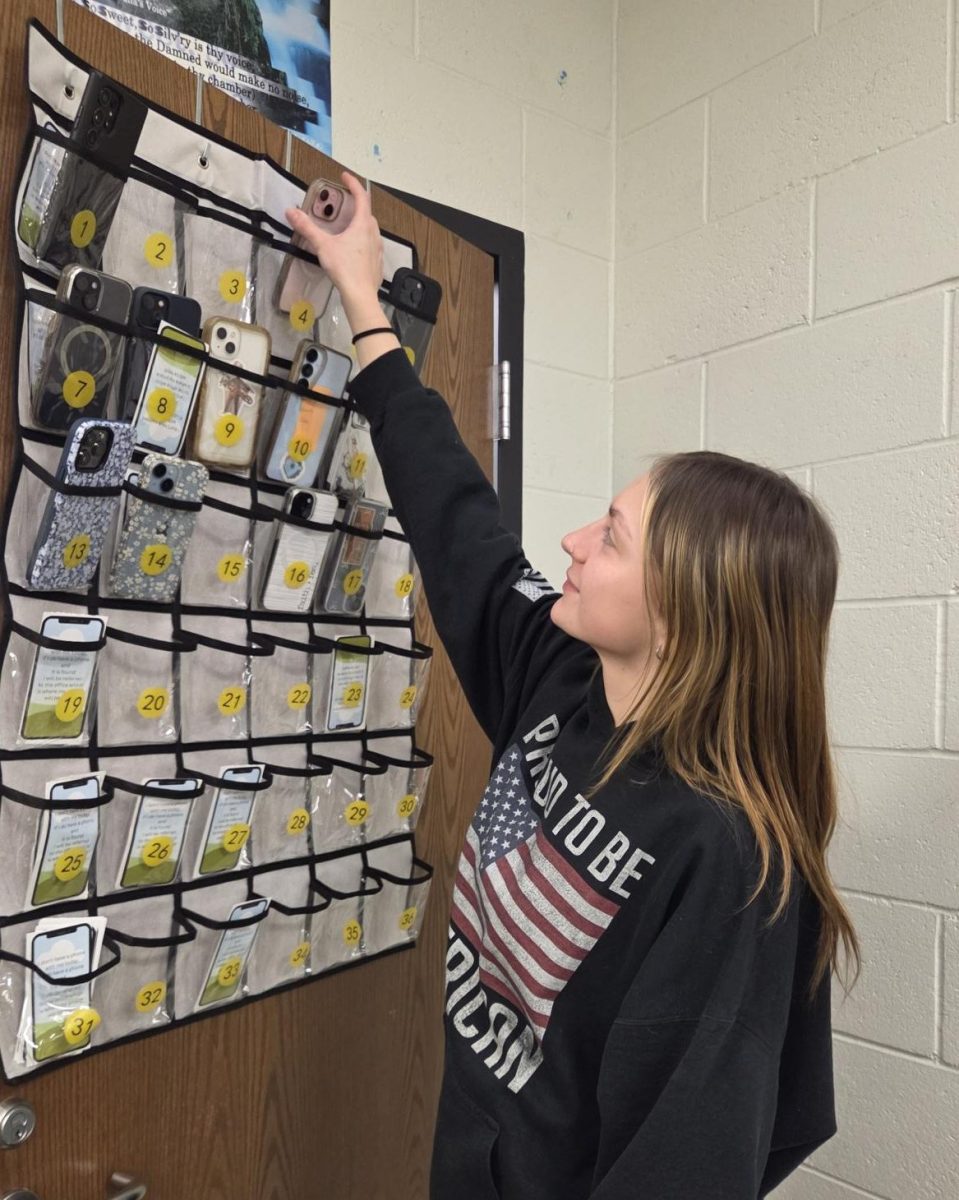
Governor Tony Evers signed a bipartisan law on October 31 regarding the use of cell phones in schools. Now called Wisconsin Act 42, the law states that all Wisconsin public school boards must implement a policy by July 1, 2026 that prohibits students from using any personal wireless communication device during instructional time.
“The new law that just passed, which is Wisconsin Act 42, requires certain levels of restriction across all schools, all grade levels, and it requires school boards to have a policy in place that restricts that use,” Superintendent Emmett Durschi said.
Despite how recent this law is, it’s gone relatively under the radar among students. The district has implemented and enforced the existing phone policy, so many students aren’t worried about what the new law will bring.
“I understand why they want to do it and I understand the benefits to it. I also feel like there should be some flexibility, like if your parents call you,” junior Anya King-Emanuele said. “If you look around the school, you’ll see that a lot of students are on their phones right now. I feel like without the law, they (the school) would allow it to happen. At the same time, if you take phones away, they’re just going to go to something else. They’re going to go to their computers, they’re going to go messing around in class instead of being on their phones.”
Other students are not so unfazed. Many are concerned about where the attention is being placed within our government.
“I think it’s a little stupid and unrealistic. I’m against it,” senior Veda Jecevicus said.
The law states that a policy must be implemented by July 2026; however, the current policies at each school within the Berlin district cover each requirement outlined in the bill.
“The policies that we currently have in place are compliant with the bill signed that is being put into place next year. There are many reasons we have our existing phone policies in place,” Assistant Principal Kurt Schommer said.
From a teacher’s perspective, the policy being backed by state law is a good thing.
“It’s about time,” science teacher Paul Bell said. “It’s (social media) a constant comparison of everyone’s best. In the sense that you have a digital persona in addition to your actual persona. There are two worlds you have to maintain. That’s unfair.”
The decision made Wisconsin the 36th state to have a ban, and took only eight months to go into effect. Though the law prohibits cell phone use, many of the specific requirements are left up to individual school boards.
“So in the law, it talks about instructional time. I think it’s more around if we will continue to allow it (personal devices) during transition times between classes and lunch or not. And I think that’s a decision that will have to be made by the principals and the leadership team and teachers working together this year,” Durschi said.
The possibility of more restrictions is real, but unlikely to create a total ban.
“Personally, as mentioned for the reasons above, I would like to have cell phone use restricted at all times of the school day except lunch,” Schommer said.
Though the reactions among students vary, the policy aims to achieve one goal: healthier habits regarding screen time.
“They’re not going away, but they have changed society. We just need to recognize how we need to change in a healthy way,’ Bell said. “Honestly, I think students understand it. I think there’s a wave of people who are recognizing that it’s not healthy. And sometimes it’s okay to have an excuse to take it away.”
Many broader implications of social media and increased screen time were also part of this decision.
“Phones can be a major distraction to student learning. Limiting phone use promotes more face-to-face interactions amongst students, leading to an improved social lifestyle and well-being,” Schommer said. “Teachers can spend less time redirecting students and more time on teaching, which creates a calmer, more productive learning environment. And last, students get a break from social media pressures, constant notifications and comparison culture, which all support healthier mental and emotional habits.”
In a broader scope, public schools around Wisconsin face similar challenges regarding students adjusting to the change.
“Governor Evers signed the law, right? It wasn’t his law, but it came to his desk. Well, he’s a former teacher, former principal, and former superintendent. He knows a little bit about education. He was a little hesitant about it because he really wants school boards and schools to make their own rules, but he also strongly believes that the purpose behind it is good,” Durtschi said.
Countering this, students offer an additional objection.
“In the future, people aren’t going to have somewhere to hide their phone unless they’re doing it on their own. When people go to college, they’re going to have distractions and access to technology that isn’t part of school. We won’t be forced to put it away, you’ll have to do it on your own,” Jecevicus said.
In other parts of the country, the phone ban has brought similar disputes, but staff members throughout the school believe whole-heartedly that less screen time will be good for students.
“I think another piece that I’m really passionate about is that I want our adults and kids to be more face to face with each other, solving problems together and talking about things; solving problems verbally together or engaging in activities that don’t involve technology all the time. We’re talking about the idea of taking a break sometimes from all the chatter and the unintended negative consequences of too much technology. I think it’s really helping us find moderation in our use of technology,” Durschi said.
Despite the controversy, it can be agreed by most that a middle-ground can be found between full restriction and a free-for-all.
“We’re always going to have technology,” Durtschi said. “So I’m hopeful that, with good communication with parents, good communication with students about the new rules or any adjustment of the rules, we will show our students why this is important. Not just that we can tell you to do this because we’re the adults and you’re the kids, but like this is why this is important and this is how it’s going to help you.”