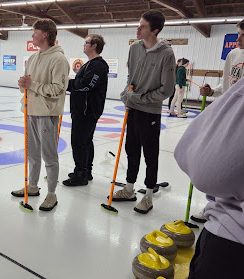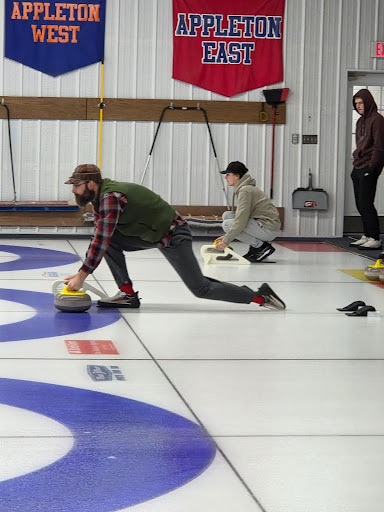
On Thursday, February 5, The AP Physics class ventured to Appleton Curling Club, a switch from their typical classroom, on Thursday, Feb. 5, In the past, the class had gone to other places to explore the application of physics, so this was a first-time experience for all.
“What I’ve done historically with the physics group is to go to EAA, but I thought, you know what, it’s the Winter Olympics. Let’s take advantage of it. I think it’s going to be an every year thing because it was just that good of an experience,” science teacher Paul Bell said.
Though only one field trip is held per year, that doesn’t stop the class from experimenting within their units.
“We’ve done a lot of activities.We’ve done one where, for two-dimensional motion, we launched rockets outside,” senior Katie Scharff said.
Bell wasn’t the only adviser for the event, as Superintendent Emmett Durtschi tagged along to see what curling entailed.
“This was my first time going curling and first time going on a field trip with the Physics class. I had shared with Mr. Bell a while back that I had an interest in learning more about curling, so he invited me to come along,” Durtschi said.
Though most field trips focus more on amusement and excitement, the physics class was constantly exercising their knowledge of motion, learning more as they curled.
“Physics is the study of motion and forces. You’re taking a 45-pound rock and sending it down the ice and rotating it, which is rotational inertia. It’s momentum, and it’s the biggest play on friction. So it’s a grab from multiple units,” Bell said.
Not only was the trip an educational experience for students, but it was an entertaining few hours spent away from their usual day.
“It was cold, but fun. At the end we were in teams of four and we played each other. My team almost won, but there was a tie breaker and we missed that,” Scharff said.
Overall, the entire curling trip was beneficial for students and staff, both educationally and leisurely.
“The students who attended seemed to have a great time. I don’t believe any of them had curled before, but by the end of two hours of training and practice, they looked like they were well on their way to becoming excellent amature curlers. I hope they also took something away from the science of the sport,” Durtschi said.