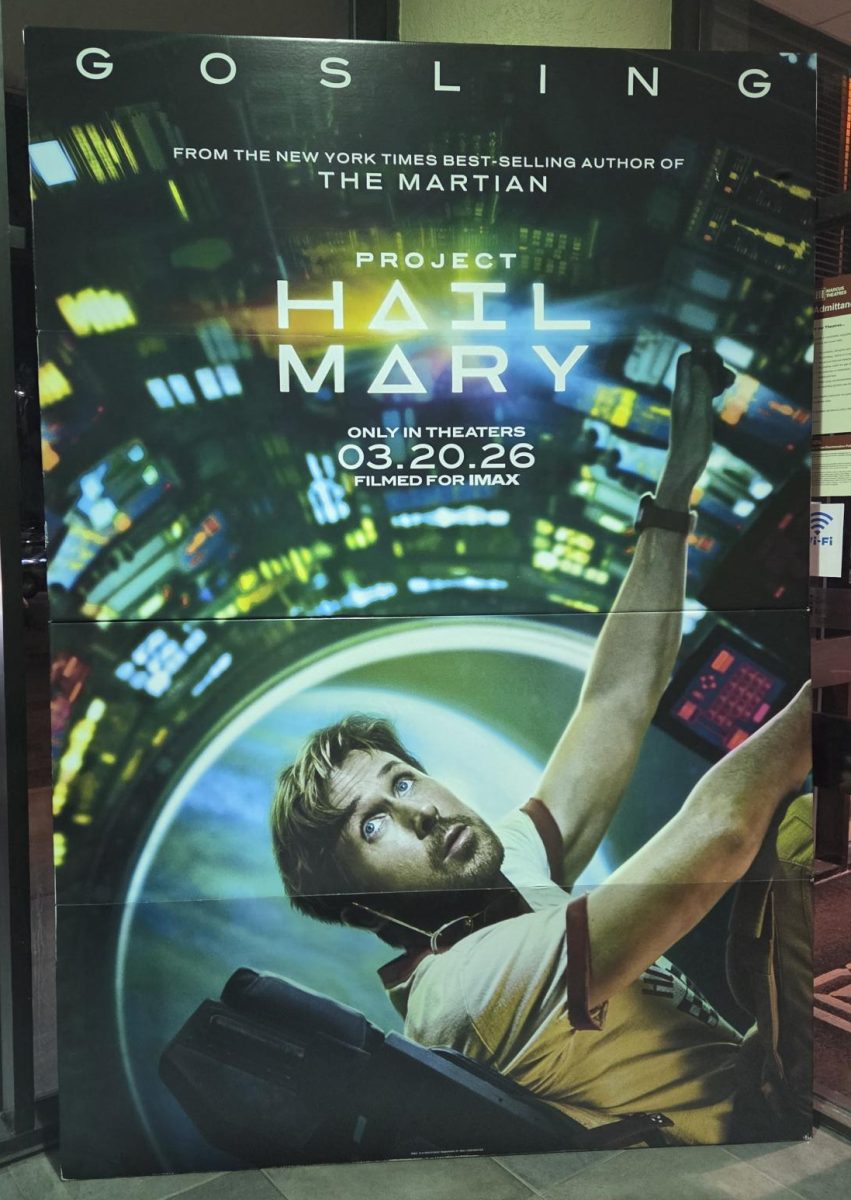
Blending humor, horror, and thrill, a long-awaited sci-fi production has recently entranced viewers around the world. Ranking second in highest grossing movies (for good reason) the film adaptation of Andy Weir’s novel “Project Hail Mary” debuted in theaters nationwide on March 20. With the first trailer being launched in June 2025, the second in November, and the third in early February, anticipation climbed through the roof in recent months as the movie’s release date grew near.
Published on May the fourth — known by many as “Star Wars Day” —, 2021, the novel captured the attention of millions of science fiction connoisseurs worldwide. Coincidentally, the film was followed closely by the launching of the Artemis II mission by NASA. Similar in content to films like Christopher Nolan’s “Interstellar” and Danny Boyle’s “Sunshine”, “Project Hail Mary” follows the journey of science teacher turned astronaut Ryland Grace on his mission to save the Milky Way from a futuristic interstellar virus. Grace is the sole survivor of the initial mission to extract data from a star 11.91 light-years away from Earth. The work sold over two million copies and won the 2022 Audie Award for Audiobook of the Year.
One critical aspect of “Project Hail Mary” both in print and on screen is the accuracy as it relates to science. To begin the novel, for example, Grace uses physics to calculate the value of gravity on the ship. This is a very pressing concern for him, as the plot begins with him having lost his memory. After many experiments, he comes to the conclusion that he is not on Earth. This specific struggle is lost in the film. There is also a scene further into the film that shows an unbalanced centrifuge, which can be peeving to picky viewers. However, similar small details were scattered throughout to keep up the authenticity of the science. Examples include proper use of vocabulary, using real space objects, and even the absence of audio effects while in the soundless vacuum that is outer space. Also, the Hail Mary (Grace’s ship) is set to arrive at a real star which is correctly addressed as Tau Ceti. Tau Ceti is currently 11.91 light-years away in real life, as stated in both works.
Despite the movie being two hours and 36 minutes long, some of the major details covered in the flashbacks of the novel were left out. For example, the virus responsible for the creation of “Project Hail Mary” caused global temperatures to drop. This was, for the most part, left out of the movie as the focus was more on the space mission, rather than the leadup.
Setting the plot aside, one of the most standout features of the film was the visuals. A majority of the movie took place inside the Hail Mary, and the technology played an important role in how viewers experienced everything. Directors truly brought each character to life with the casting. Ryan Gosling played Grace, and he almost had to act for two different people. The book and movie feature many time shifts, and Gosling’s character looked and acted very differently in the past compared to the present.
A controversial piece, not of the film, but of the trailers, was the decision to feature well-loved character, Rocky, who Grace meets in his travels. In the novel’s summary on the back cover, Weir wrote, “And with the clock ticking down and the nearest human being light-years away, he has to do it all alone. Or does he?” Weir leaves a very ambiguous hint towards the inclusion of other characters on Grace’s ship, but the trailers were much more blunt. The first official trailer featured one scene at the end, of a mysterious ship connecting with the Hail Mary, and what appears to be a limb knocking on the glass acting as a barrier between the two vessels. The second and third official trailers gave this character ample screen time, which took away much of the shock associated with extra-terrestrial life one would experience while reading the book.
However, it would be incredibly difficult to review this adaptation without including Rocky, as he was portrayed beautifully. His character, voiced by James Ortiz, who is known as a puppeteer for Broadway shows, offers an abundance of spunk, wit, and sarcasm that really nicely breathed life into the character bibliophiles adored while reading.
All things considered, making a film for a nearly 500-page book is an extremely difficult task. Though some scenes were rushed or omitted, the directors did a fantastic job capturing the emotional drives throughout the movie. “Project Hail Mary” in film and verse earns a well-deserved 5/5 and a big thumbs down.