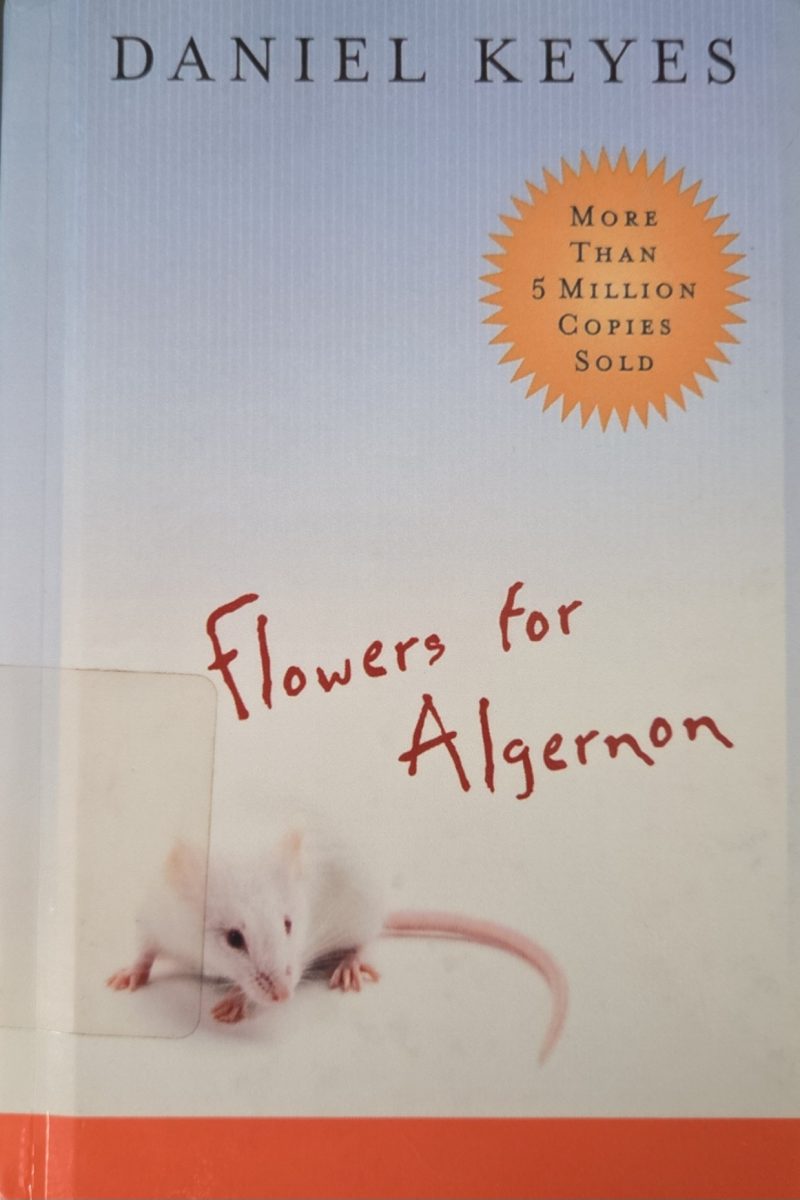
Daniel Keyes’ classic novel “Flowers for Algernon” captures a hopeful and tear-jerking journey, beginning with a 32-year-old Charlie Gordon and his befriended mouse, Algernon. The book was first published in The Magazine of Fantasy & Science Fiction as a short story in 1959, but was expanded into a novel and republished in 1966. Many have attempted to create film adaptations, like “Charly” (1968), “Flowers for Algernon” (2000), and “Flowers for Algernon” (2013), but the book remains the most well-recognized.
Charlie was abandoned by his parents at a young age and lives alone with a significant intellectual disability. While taking classes at a school specializing in adults with disabilities, Charlie meets a professor who evaluates him for an experimental study that changes his life.
The experiment Charlie was chosen for involved a new neurosurgery that would repair parts of the brain responsible for memory by increasing brain activity. The process was performed first on mice, and the most notable of these mice was named Algernon. In somewhat of a slow-burn, enemies-to-friends kind of way, Charlie despised Algernon from the beginning. Algernon outperformed Charlie in nearly every way.
As the novel progresses, so does Charlie’s intelligence. The book is written in an entry format, with daily progress reports rather than chapters. Throughout the course of the study, Charlie’s spelling, grammar, and punctuation drastically improved. Words like “progris” and “dint” turn into “progress” and “didn’t”; and simple descriptive sentence fragments turn into complex thoughts and emotions. In addition to this, Charlie finds himself warming up to the mouse who occupies his advancement in the experiment’s following procedures.
The style throughout does an excellent job portraying Charlie as a character, sentences and form flow as he does. This not only displays success within the study, but creates personal ties between the reader and storyline.
The novel takes a sudden turn when Charlie discovers that Algernon had an intense regression in health. With his newfound intelligence, he is left to wonder if that fate is in his future as well. Putting a devastating twist on the old saying, “ignorance is bliss”, Keyes leaves readers to question their own thoughts. Would they want to know their life could end, and soon? Would they have chosen to partake in the experiment in the first place? What, if anything, could save Charlie from this cruel ending?
From dishonest friends to personal improvement, Keyes demonstrates many smaller themes underneath the big picture, effectively creating a melancholic story that resonates with readers for years after the first read. Keyes’ “Flowers for Algernon” is more than worthy of a 5/5.