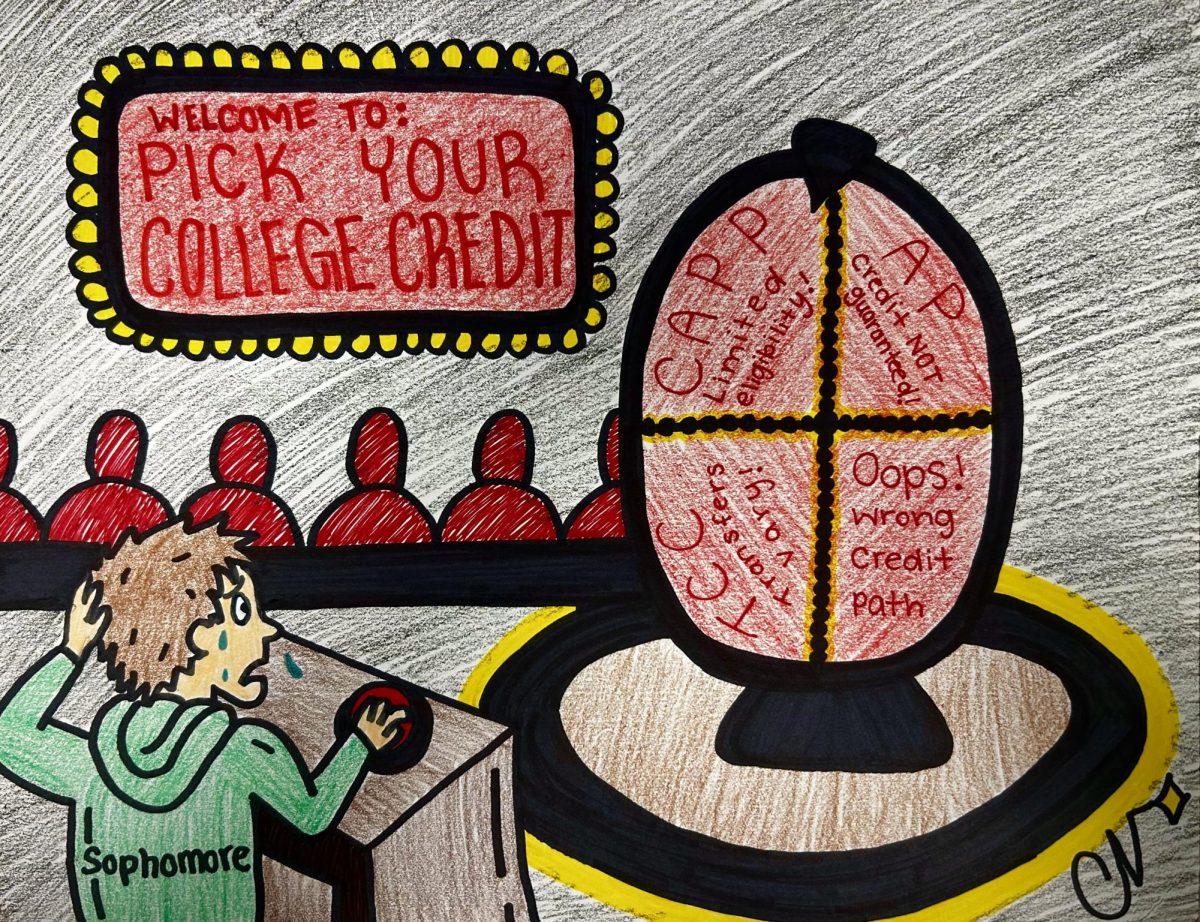
One of the hardest choices a sophomore makes is choosing their junior year schedule. So many more options are available, including college-credit classes, whether through CAPP (Cooperative Academic Partnership Program), TCC (Technical College Credit), or AP (Advanced Placement). CAPP credits are offered by the University of Wisconsin-Oshkosh, TCC credits are offered by Moraine Park Technical College, and AP by College Board.
With the option to take classes that can replace others in the future, weighing the options can be stressful. CAPP credits can transfer to four-year and two-year colleges, and they do transfer out of state, depending on the other colleges’ policies. CAPP is also the only program that charges students, the price being $115 per credit. There is also a possible attendance requirement that can affect whether students earn credit. The classes offered are specifically only in advanced English, math, and social studies, requiring a rigorous commitment from students. Taking a CAPP class means more than just maintaining a good grade; it’s an investment of money and time.
TCC classes are another good option for students, with the majority of Berlin’s offerings being science, FACS, technology, and English-centered. There is no payment for TCC courses, though a downside is that they are nontransferable to four-year colleges. The only conflict they share is that for TCC English classes, they cannot be transferred to non-tech colleges, and they should not be taken with CAPP English. Students should not have to immediately determine whether they’ll be attending a four or two-year university upon choosing classes, though that is what it seems the current process is. Post-graduate plans can change easily, and though deciding what college course to take may seem intimidating, everything can be easily switched by editing schedules.
Finally, the only other way that students can earn a college credit is through AP classes. There are currently only three offered at BHS: AP Psychology, AP Physics, and AP Music Theory, each a free full-year course. Students have the option to opt out of the AP exam at the beginning of the year, determining whether they take the class for both semesters or just one. If they register and eventually drop the elective, students are in charge of paying a $40 testing fee and miss out on earning a potential credit. A small stipulation to those taking the full-year course is the chance of not earning the college credit, as to get it, students need to score a three or higher on the AP exam. The exam is out of five, and a score of two or below automatically disqualifies any student. They aren’t losing money, but the possibility of one less course taken.
A small but important fact that most students look past is that by combining CAPP and AP classes, most general education courses, along with English and math, can be fully completed for their freshman year. With standard requirements already met, the transition from high school to college can be smoother, with a lighter class schedule allowing greater focus on more rigorous courses.
Overall, the choice of college credits students make is extremely important for their future. While the decision does require students to assume where they’ll end up after high school, which can be troubling, it can be a great head start to students’ later education, as long as they pick wisely.