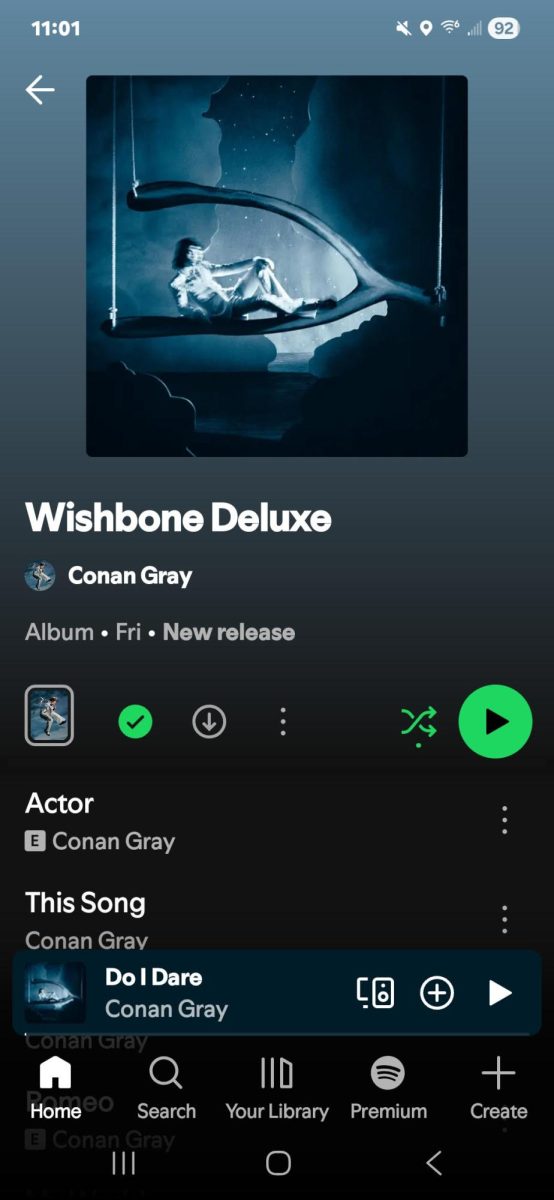
Honesty, regret, and wishful thinking are the main themes in singer-songwriter Conan Gray’s marvelous continuation of his latest album, “Wishbone Deluxe.”
The standard edition of the album featured 12 extraordinary tracks, released on August 15, 2025. Two tours followed: The Wishbone Pajama Show, which spanned limited North American cities over the course of one month (Sept-Oct), and Wishbone World Tour, which picked up in January and is set to continue through early October. The very first night of the second tour debuted an unreleased song, “The Best,” that many fans speculated to be a deluxe track on a hopeful extended album. That theory was confirmed on March 20, the final show of the United States leg, as Gray announced that “The Best” would be released as a single the next week, in addition to his deluxe album, set to release on April 24.
On April 15, a mere week before the release, Gray decided to send listeners on a spiral of internet rabbit holes and research. He announced through a fans-only text message that he had scattered the four unreleased track names “as clues hidden across the internet.” The first track name was found on his Instagram account, in his bio, which had switched to “13. Do I Dare.” The second was on an Instagram post, as fans had to play a crossword puzzle to find the long title, “House That Always Rains.” The next song was found through both the crossword puzzle and a playlist created on Spotify, which ultimately led to the title of “Door,” and the final track’s name was under stickers on his website, titled “Moths.”
Track 13, “Do I Dare,” begins the deluxe on a hopeful note, Gray’s typically mature vocals sounding more youthful in comparison to prior songs. The premise of the track is focused on pondering reaching out to someone, missing a prominent figure, and contemplating what bad would really occur if they came back. It is a violin-heavy song, similar to “This Song,” with moments of rushed drums and guitar, a callback to the second verse of “Nauseous.” The song that follows, “House That Always Rains,” begins with an almost folk-country guitar melody, an upbeat start to a song with rumors to be anything but happy. The song recalls both the childhood of Gray and his past partner, highlighting his suburban Texas roots compared to a “city slick” private school boy. He uses their upbringings as an explanation for their insecurities, primarily in the infectiously memorable chorus. Gray sings, “Oh, I saw you in the doorframe of the house that always rains/Come and find me, ’cause they’re shouting in my house that always shakes/Don’t that explain why we’re afraid of love?” To many fans, the lyrics sound like a continuation of a song on Gray’s sophomore album, “Superache,” titled “Family Line.” While they both speak about familial trauma, “House That Always Rains” decidedly masks the sorrow with a fun beat, making it like any other “Wishbone” track.
While the first two tracks maintained an upbeat and fun feel, the final three were almost complete opposites. “Door,” having been teased in snippets on Gray’s social media, was already known to be an agonizing acoustic ballad, in the same detached way that “Connell” had been. If “Connell” had been depressing, “Door” was desensitizing. A chilling acoustic guitar, drums, and strings layer hauntingly behind Gray’s voice, making the song somehow even more distraught. “Moths” immediately begins with mentioning the previous track, saying that though the door is closed, windows are open, and lights are shining, happily greeting any moths flying in. The instrumental, which was played by Noah Conrad throughout all of “Wishbone,” features a soft guitar strummed slowly and sets an eerie tone of anticipation. Waiting for the climax of the song, the all-at-once clash of drums, guitar, and various percussion instruments kept the listener engaged, as if the lyrics of longing and yearning didn’t do that well enough. The post-chorus layers the original chorus with what could be interpreted as Gray’s thoughts effortlessly, the same structure used at the end of “Sunset Tower” as well. Gray sings, “So I won’t beg (Might be missin’ you forеver, but you’re evеry song I sing)/But if you need me (And every letter, every word that we don’t speak)/Just turn around (Holds us together, I will always be your friend)/Just turn around.” The track has already been deemed a fan favorite, totalling 885,273 streams on release day.
The official album closer, “The Best,” seems to finally end the Wishbone chapter in a solemn but hopeful way. Similar to “Care,” the closer on the standard album, Gray sings about making amends, though nothing of holding on or, blatantly, stilling pining. The post-chorus, “I could make peace with it, finally sleep with it/Finally wish you the best,” is nothing but kind, pure, wishing, a very prominent theme to the album itself. Gray’s tenor voice in the bridge projects hurt, raw harmonies, almost piercing the ears of listeners with utter numbness and regret. He sings, “Sometimes I wonder, were we ever even friends/Sometimes I wonder if it really is the end/I wanna watch you while the words come out your mouth/That you don’t miss me like/I know you miss me now.” This official album closer wraps up the Wishbone experience seamlessly, leaving no pages unturned. While the standard album’s end track was phenomenal in itself, “The Best” amplified the meaning and importance of Wishbone, leaving listeners with a full, satisfying ending.
Overall, the five deluxe tracks to “Wishbone” add a poignant, harrowing feel to an already perfect album, earning an obvious and easy 5/5.