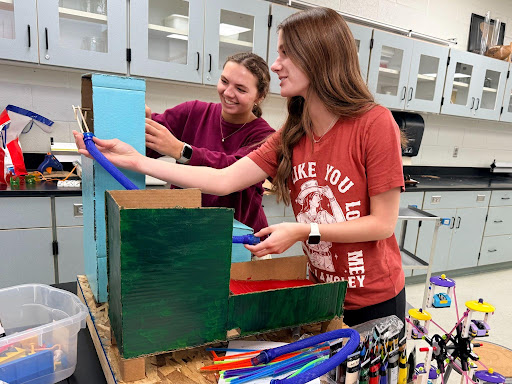
Though complex, physics is an essential part of understanding the world around us. While a rudimentary understanding of physics is given to most students, those taking AP Physics dive exponentially deeper into the subject. Now that their physics coursework is finished, those in the class are both preparing for the AP exam while simultaneously working on Rube Goldberg machines. Rube Goldberg machines, put simply, are contraptions that are purposely sophisticated but meant to perform a simple, everyday task.
“It’s a ton of complex steps to then activate one simple thing like pressing a button,” senior Eric Dahnke said.
The construction process of a Rube Goldberg is anything but linear. Most groups start with the final step, like flipping a switch, pressing a button, or ringing a bell. Then, students work to determine how to trigger that final step, and how to trigger that trigger, and so on. While it may seem counterintuitive, constructing a Rube Goldberg in this way makes sure the machine has a functional end goal, and that its beginning will achieve the steps necessary to trigger said end goal.
“We are going from the end of it to the beginning of it. We make the final step, and then we build off of that and learn how to trigger that,” Dahnke said.
While not extremely constraining, the guidelines put in place are still a major part of each group’s plans and methods. Each team’s machine must have at least six transfers of energy, which they can get from a massive number of contraptions and devices.
“We start with a requirements list,” senior Ashley Dretske said. “Then, we just start bringing in all of our supplies, and honestly, it’s kind of a free-for-all, whatever you can get done in a day.”
Even with the guidelines put in place, creativity is still essential to the building process. Each team, for example, requires a theme for their machine. These themes range across the spectrum, from movies to real-world places. Though creative in nature, these themes didn’t need to be purely cosmetic.
“Ours is a carnival theme, so we start off with the ‘Down the Clown’ game; which is how we start the transfer of energy,” Dretske said.
Throughout the process, each group learns not only about their own mechanical systems, but also the practical applications of the concepts they learned earlier in the course. Though not everything on the machines will work perfectly the first time, the point of constructing these machines is to also simply build problem-solving skills.
“It’s all a learning experience. I see it every day, there’s no set, ‘This is how it has to happen’,” science teacher Paul Bell said.
Rube Goldberg machines allow students in AP Physics to unwind and lessen coursework for their final AP exam on May 6, while also reviewing many of the concepts they learned about throughout the course. While challenges may arise during the construction of the machines, the final products cement the real-world applications of these concepts in a more interesting way than a textbook.
“That’s (projects) something that I personally try to shift towards, just because we need to get some foundational skills, and if there are certain projects that trip people’s triggers, that’s a win, and it doesn’t matter what specific project it is,” Bell said.